Complete cohort - Case 27 of 83
Case 31
Assigned out-of-fold recommendation
Coil embolization alone
Alternative: Balloon-assisted coil embolization
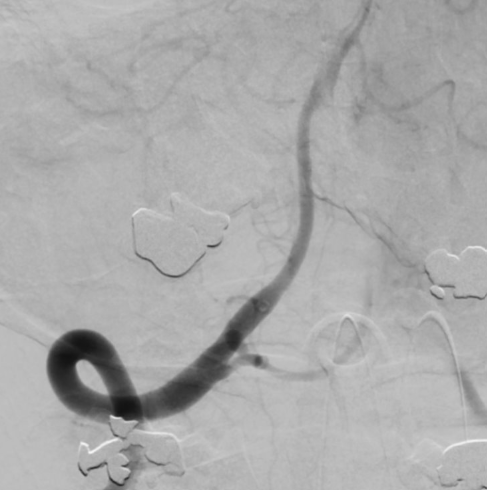
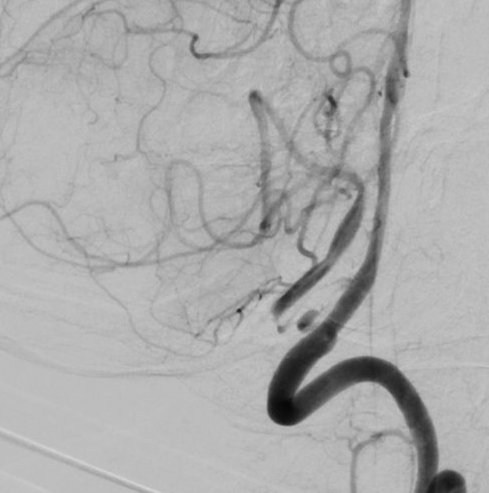
View A is AP; View B is lateral, as confirmed by the data provider.
Case summary
A 64-year-old male presented with extensive subarachnoid hemorrhage (HH5mF4) and was found to have a 3.4 mm x 1.7 mm proximal dissecting pseudoaneurysm of the right PICA.
Image observation
On the supplied views, a catheter is visible within the posterior circulation, and the vessel anatomy appears tortuous.
Model-generated clinical rationale
The assigned recommendation of coil embolization alone is questionable given the documented diagnosis of a dissecting pseudoaneurysm, which typically requires flow diversion or stenting rather than simple coiling. The rationale is further limited by the lack of specific morphological details regarding the aneurysm neck or parent vessel caliber in the provided text.
Model uncertainty
The OOF score distribution was diffuse: Coil embolization alone ranked first, but Balloon-assisted coil embolization remained a material alternative.
Clinical uncertainty / missing factor
The most critical missing decision factor is the specific aneurysm morphology and neck width, which are required to determine the feasibility of endovascular occlusion.
Explicit evidence used
64-year-old male with extensive SAH (HH5mF4) | 3.4 mm x 1.7 mm proximal dissecting pseudoaneurysm of the right PICA