Complete cohort - Case 75 of 83
Case 90
Assigned out-of-fold recommendation
Stent-assisted coil embolization
Alternative: Coil embolization alone
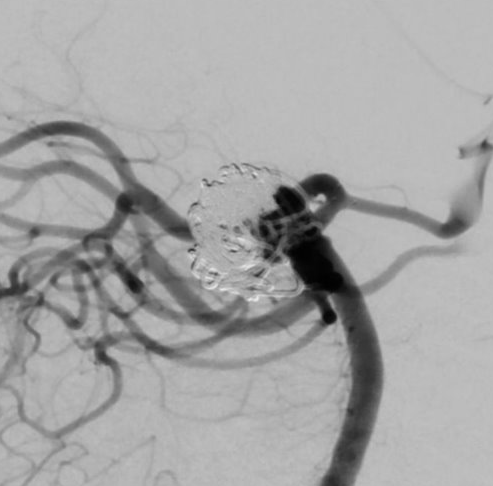
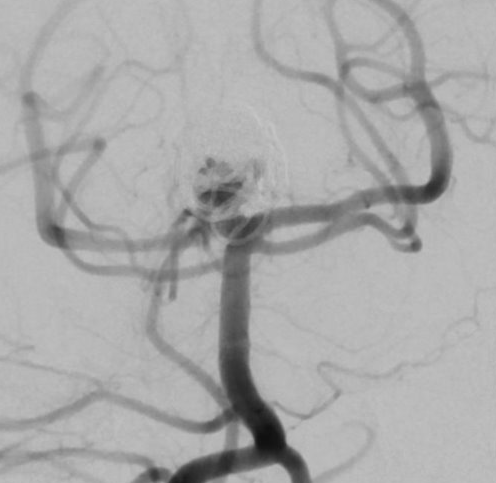
View A is AP; View B is lateral, as confirmed by the data provider.
Case summary
A 74-year-old female presents with a recurrence of a previously treated basilar apex aneurysm.
Image observation
On the supplied views, a dense coil mass appears to occupy the aneurysm sac at the basilar apex, with patent flow in the adjacent posterior cerebral arteries.
Model-generated clinical rationale
The assigned recommendation of stent-assisted coil embolization is supported by the documented recurrence, which often necessitates a scaffold to prevent coil prolapse and improve packing density. However, the rationale is limited by the lack of specific morphological data regarding the aneurysm neck width or the presence of critical branch vessels that would mandate stent protection.
Model uncertainty
The OOF classifier showed a relatively clear preference for Stent-assisted coil embolization over Coil embolization alone, but its scores are not probabilities of clinical correctness.
Clinical uncertainty / missing factor
The most significant missing decision factor is the specific aneurysm morphology, particularly the neck-to-dome ratio and the involvement of perforating arteries, which are critical for determining the necessity of stent assistance.
Explicit evidence used
74-year-old female | recurrence of previously treated basilar apex aneurysm