Complete cohort - Case 17 of 83
Case 20
Assigned out-of-fold recommendation
Flow disruption (intra-saccular)
Alternative: Flow diversion alone
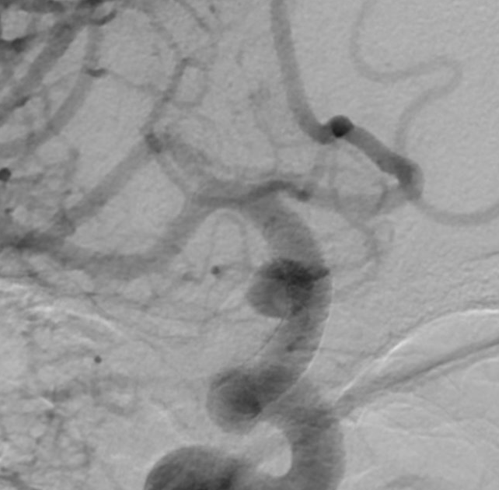
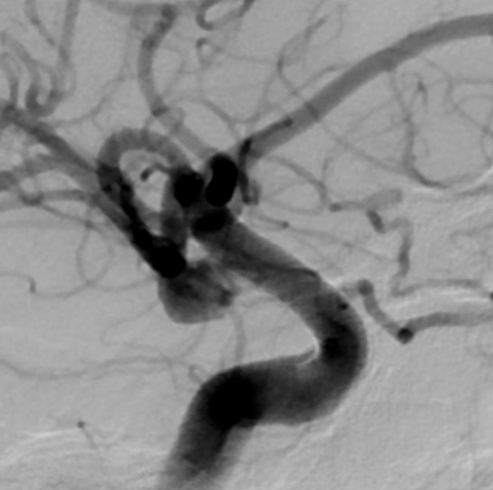
View A is AP; View B is lateral, as confirmed by the data provider.
Case summary
An 80-year-old female presents for retreatment of a recurrent right posterior communicating artery aneurysm following prior flow diversion.
Image observation
On the supplied views, the aneurysm appears as a distinct filling defect arising from the posterior circulation with visible contrast stagnation within the sac.
Model-generated clinical rationale
The assigned recommendation of flow disruption is supported by the documented contrast stagnation, which suggests a wide-necked morphology or complex flow dynamics that may favor intra-saccular devices. However, the history of prior flow diversion complicates the assessment of vessel wall integrity and device feasibility. The rationale is limited by the lack of specific neck width measurements or detailed morphological descriptions required to definitively select between flow disruption and diversion.
Model uncertainty
The OOF classifier scores for Flow disruption (intra-saccular) and Flow diversion alone were close, so the assigned recommendation should be treated as uncertain.
Clinical uncertainty / missing factor
The most critical missing decision factor is the precise aneurysm neck width and the specific status of the parent vessel wall following the previous flow-diverting stent.
Explicit evidence used
Contrast stagnation within the body of the aneurysm | History of previously treated right posterior communicating artery aneurysm via flow-diversion