Complete cohort - Case 24 of 83
Case 28
Assigned out-of-fold recommendation
Stent-assisted coil embolization
Alternative: Flow disruption (intra-saccular)
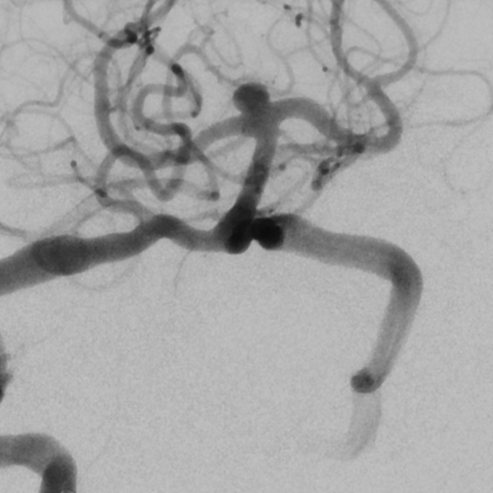
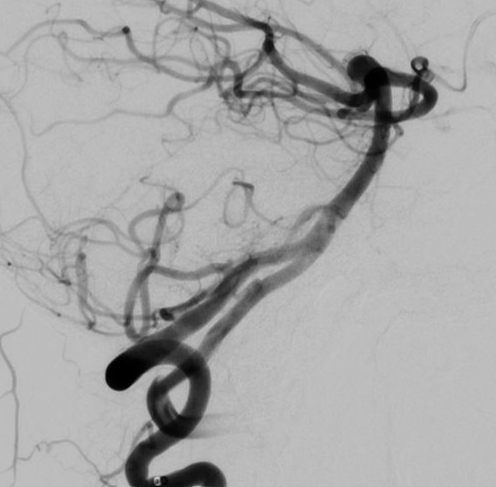
View A is AP; View B is lateral, as confirmed by the data provider.
Case summary
A 65-year-old female presents with an unruptured basilar apex aneurysm measuring 4.6 x 4.9 x 5.1 mm with a 4.8 mm wide neck.
Image observation
On the supplied views, the aneurysm appears as a posteriorly and superiorly projecting outpouching at the basilar terminus with a wide neck relative to the dome.
Model-generated clinical rationale
The assigned recommendation of stent-assisted coil embolization is supported by the wide neck width (4.8 mm), which typically necessitates a stent to maintain coil stability. However, the recommendation is limited by the lack of documented assessment regarding the incorporation of the posterior cerebral arteries or the feasibility of preserving the prominent left AICA-PICA complex.
Model uncertainty
The OOF classifier scores for Stent-assisted coil embolization and Flow disruption (intra-saccular) were close, so the assigned recommendation should be treated as uncertain.
Clinical uncertainty / missing factor
The most significant missing decision factor is the specific relationship of the aneurysm neck to the origins of the posterior cerebral arteries, which determines the safety of stent placement versus flow disruption.
Explicit evidence used
4.8 mm wide neck | 4.6 x 4.9 x 5.1 mm aneurysm dimensions