Complete cohort - Case 29 of 83
Case 33
Assigned out-of-fold recommendation
Coil embolization alone
Alternative: Balloon-assisted coil embolization
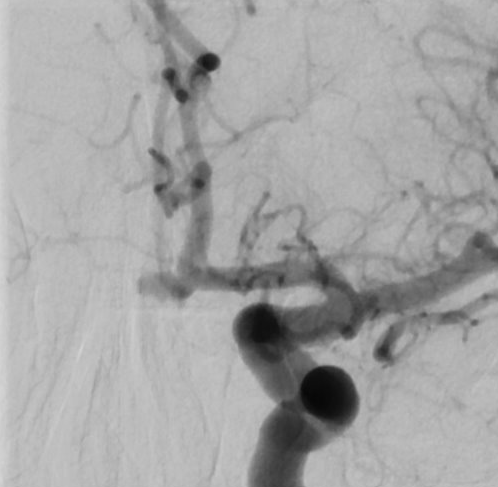
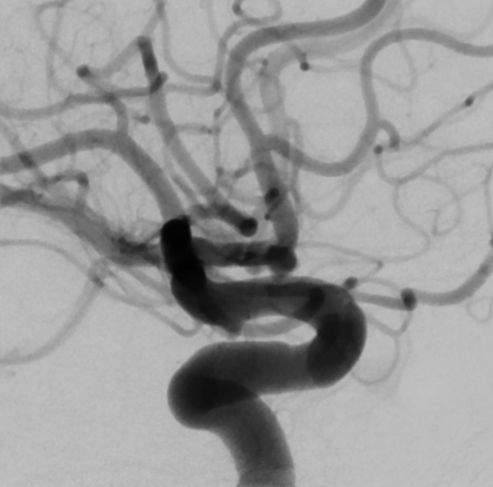
View A is AP; View B is lateral, as confirmed by the data provider.
Case summary
A 66-year-old female presents with aneurysmal subarachnoid hemorrhage (Hunt Hess 3) due to a suspected ruptured anterior communicating artery aneurysm.
Image observation
On the supplied views, a saccular aneurysm appears at the anterior communicating artery junction with a rightward projection and irregular lobulated morphology.
Model-generated clinical rationale
The assigned recommendation of coil embolization alone is supported by the documented small aneurysm dimensions (4.2 x 2.8 x 2.4 mm) and the presence of a defined 1.9 mm neck. However, the documented irregular lobulated morphology and the aneurysm's location at the A1/A2 junction may complicate coil stability, potentially necessitating balloon assistance despite the model's preference.
Model uncertainty
The OOF classifier showed a relatively clear preference for Coil embolization alone over Balloon-assisted coil embolization, but its scores are not probabilities of clinical correctness.
Clinical uncertainty / missing factor
The most significant missing decision factor is the precise neck-to-dome ratio and the exact relationship of the aneurysm neck to the A2 origin, which are critical for determining if simple coiling is feasible.
Explicit evidence used
Aneurysm dimensions 4.2 x 2.8 x 2.4 mm with 1.9 mm neck | Irregular lobulated saccular morphology at A1/A2/A-comm junction