Complete cohort - Case 30 of 83
Case 37
Assigned out-of-fold recommendation
Coil embolization alone
Alternative: Balloon-assisted coil embolization
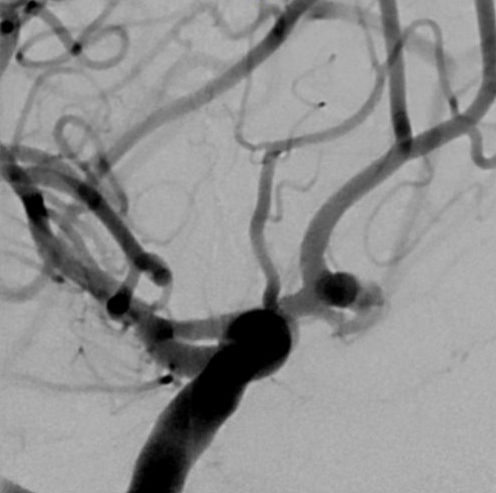
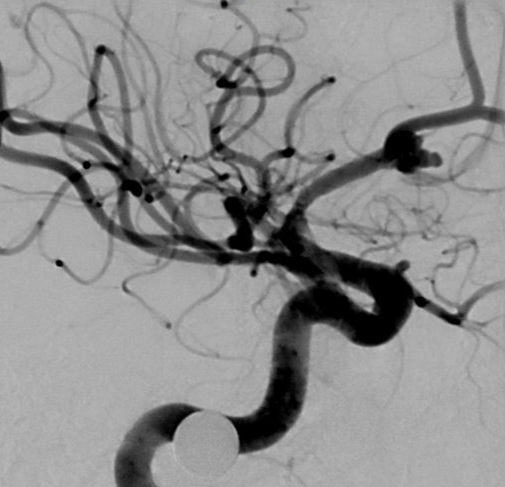
View A is AP; View B is lateral, as confirmed by the data provider.
Case summary
A 55-year-old male presented with subarachnoid hemorrhage and was found to have a 3mm x 5.7mm x 3.4mm aneurysm with a 3.5 mm neck projecting from the ACOM artery.
Image observation
On the supplied views, a saccular outpouching appears at the anterior communicating artery junction, with adjacent branch vessels visible in the working projections.
Model-generated clinical rationale
The assigned recommendation of coil embolization alone is supported by the documented 3.5 mm neck width, which may allow for primary coil packing without adjunctive devices. However, the narrative explicitly notes the complex morphology of the aneurysm, which limits the certainty of this approach and suggests that balloon assistance might be required to maintain coil stability.
Model uncertainty
The OOF score distribution was diffuse: Coil embolization alone ranked first, but Balloon-assisted coil embolization remained a material alternative.
Clinical uncertainty / missing factor
The specific geometric configuration of the complex morphology and the precise angle of the neck relative to the parent vessel remain uncertain factors for determining the necessity of balloon assistance.
Explicit evidence used
3mm x 5.7mm x 3.4mm aneurysm with 3.5 mm neck | complex morphology of this aneurysm