Complete cohort - Case 33 of 83
Case 41
Assigned out-of-fold recommendation
Coil embolization alone
Alternative: Balloon-assisted coil embolization
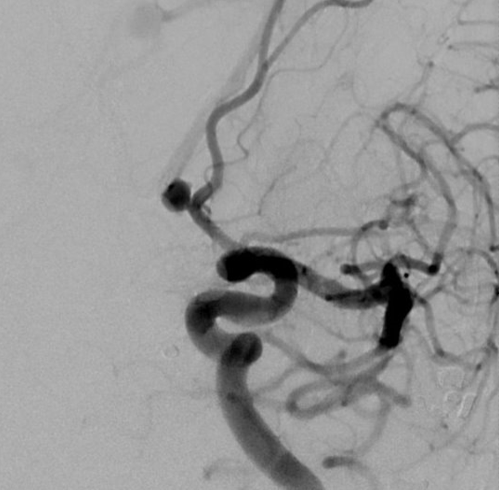
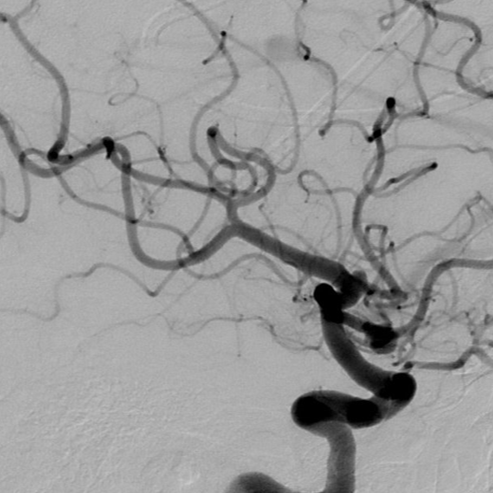
View A is AP; View B is lateral, as confirmed by the data provider.
Case summary
A 63-year-old woman presented with subarachnoid hemorrhage and multiple cerebral aneurysms, including a likely ruptured 4.5mm aneurysm at the left A1-A2 junction.
Image observation
On the supplied views, the intracranial vasculature appears patent with a visible aneurysmal outpouching and associated branching vessels.
Model-generated clinical rationale
The assigned recommendation of coil embolization alone is supported by the documented 2mm neck width of the target aneurysm, which suggests a favorable neck-to-dome ratio for standard coiling. However, the presence of an irregular aneurysm morphology and the incorporation of branch origins in other documented lesions limit the certainty of this approach without further anatomical detail.
Model uncertainty
The OOF classifier scores for Coil embolization alone and Balloon-assisted coil embolization were close, so the assigned recommendation should be treated as uncertain.
Clinical uncertainty / missing factor
The specific neck-to-dome ratio and precise branch incorporation of the ruptured A1-A2 aneurysm are not fully defined, which are critical factors for determining the necessity of balloon assistance.
Explicit evidence used
4.5mm x 4.5mm x 5mm aneurysm with a 2mm neck | aneurysm projecting inferiorly from the anterior communicating artery complex