Complete cohort - Case 2 of 83
Case 5
Assigned out-of-fold recommendation
Coil embolization alone
Alternative: Stent-assisted coil embolization
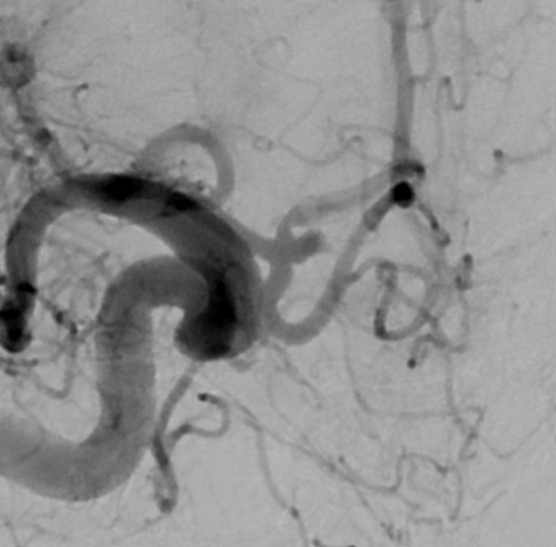
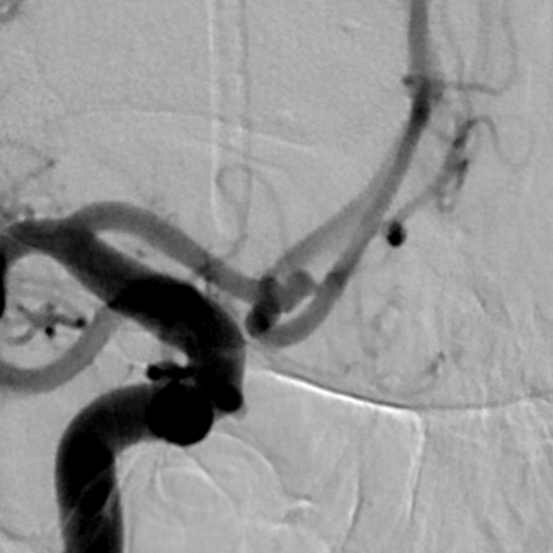
View A is AP; View B is lateral, as confirmed by the data provider.
Case summary
A 58-year-old male presented with a Hunt and Hess 5 subarachnoid hemorrhage caused by a 2.5 mm x 2.1 mm anterior communicating artery aneurysm with a 1.8 mm neck.
Image observation
On the supplied views, the aneurysm appears as a small, contrast-filled outpouching arising from the anterior communicating artery complex.
Model-generated clinical rationale
The assigned recommendation of coil embolization alone is supported by the aneurysm's small dimensions and the documented 1.8 mm neck, which may allow for primary occlusion. However, the superior and medial orientation of the neck and the presence of contralateral A2 filling suggest that maintaining patency of the communicating artery could be challenging, potentially necessitating adjunctive support.
Model uncertainty
The OOF score distribution was diffuse: Coil embolization alone ranked first, but Stent-assisted coil embolization remained a material alternative.
Clinical uncertainty / missing factor
The critical missing decision factor is the precise morphological assessment of the neck-to-dome ratio and the exact angle of the neck relative to the parent vessel, which determines the feasibility of coil retention without stenting.
Explicit evidence used
2.5 mm x 2.1 mm anterior communicating artery aneurysm | 1.8-mm neck directed superiorly and medially