Complete cohort - Case 47 of 83
Case 56
Assigned out-of-fold recommendation
Coil embolization alone
Alternative: Balloon-assisted coil embolization
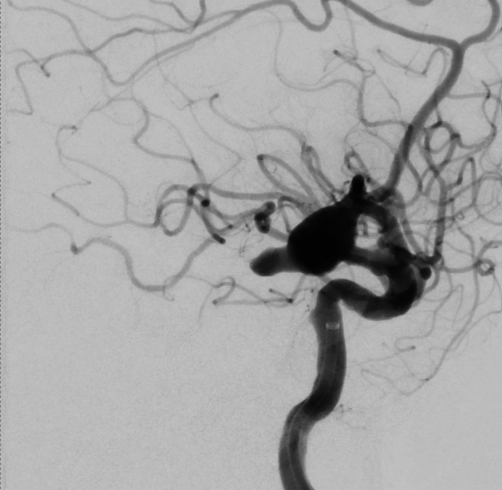
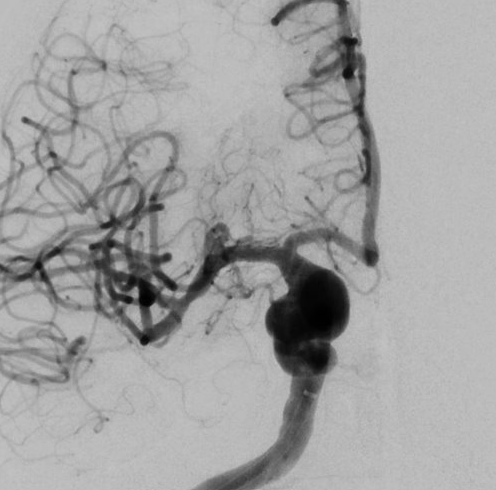
View A is AP; View B is lateral, as confirmed by the data provider.
Case summary
A 72-year-old female presents with an incidental unruptured right supraclinoid internal carotid artery aneurysm characterized by a large fusiform component and a smaller posteriorly projected saccular component.
Image observation
On the supplied views, a large, complex aneurysmal dilation appears to involve the supraclinoid internal carotid artery, with a distinct saccular outpouching visible against the background of the cerebral vasculature.
Model-generated clinical rationale
The assigned recommendation of coil embolization alone targets the documented saccular component, which is the primary site of rupture risk. However, the presence of a large underlying fusiform segment and a small daughter lobule suggests that simple coiling may be technically challenging or insufficient for complete exclusion. The lack of a visualized posterior communicating artery limits the potential for balloon-assisted remodeling from that direction, though the fusiform nature remains a significant constraint.
Model uncertainty
The OOF score distribution was diffuse: Coil embolization alone ranked first, but Balloon-assisted coil embolization remained a material alternative.
Clinical uncertainty / missing factor
The precise neck width and the extent of fusiform involvement relative to the saccular component are critical missing factors for determining the feasibility of coil-only treatment versus flow diversion.
Explicit evidence used
72-year-old female with incidental unruptured aneurysm | Right supraclinoid ICA fusiform aneurysm with saccular component | No visualized posterior communicating artery