Complete cohort - Case 48 of 83
Case 57
Assigned out-of-fold recommendation
Coil embolization alone
Alternative: Balloon-assisted coil embolization
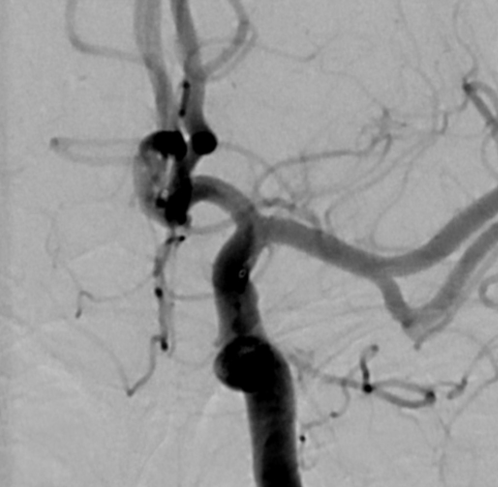
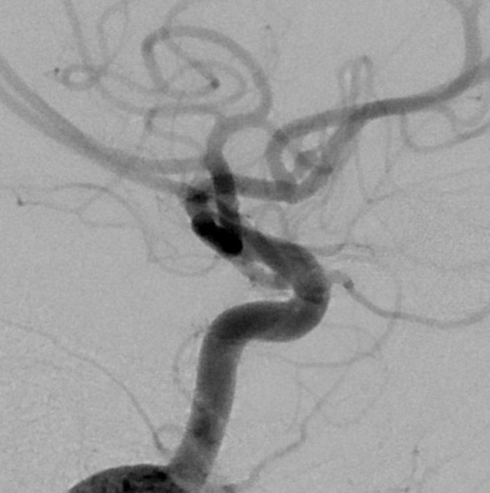
View A is AP; View B is lateral, as confirmed by the data provider.
Case summary
A 38-year-old female with a Hunt and Hess 2 subarachnoid hemorrhage presents with a 3.8 x 2.1 mm tubular anterior communicating artery aneurysm with a 1.2 mm neck.
Image observation
On the supplied views, a saccular outpouching appears at the anterior communicating artery junction with a visible neck and superior projection.
Model-generated clinical rationale
The documented 1.2 mm neck width and tubular morphology suggest a geometry that may be amenable to coil embolization alone. However, the small aneurysm size and specific neck-to-dome relationship limit the certainty of this approach without adjunctive balloon support.
Model uncertainty
The OOF score distribution was diffuse: Coil embolization alone ranked first, but Balloon-assisted coil embolization remained a material alternative.
Clinical uncertainty / missing factor
The precise neck-to-dome ratio and the exact relationship of the aneurysm neck to the A2 origin remain the critical missing factors for determining coil stability.
Explicit evidence used
3.8 x 2.1 mm tubular anterior communicating artery aneurysm | 1.2 mm neck