Complete cohort - Case 59 of 83
Case 74
Assigned out-of-fold recommendation
Balloon-assisted coil embolization
Alternative: Coil embolization alone
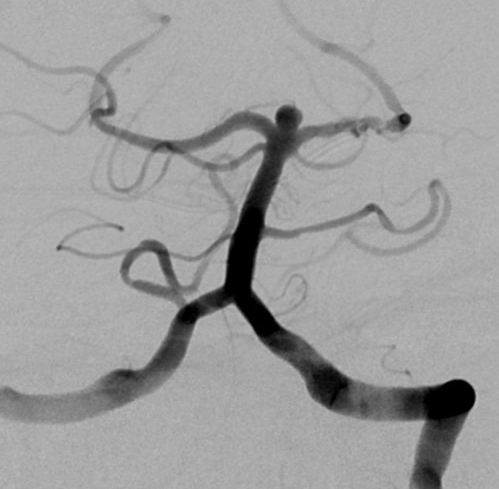
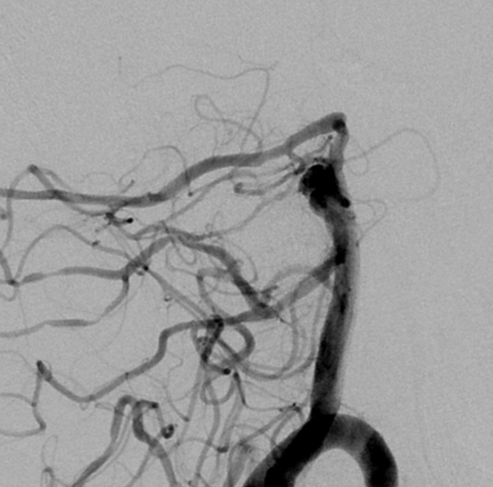
View A is AP; View B is lateral, as confirmed by the data provider.
Case summary
A 79-year-old female presented with intraventricular hemorrhage and a 5.5 mm saccular basilar apex aneurysm with a 2.5 mm neck that does not incorporate the posterior cerebral artery origins.
Image observation
On the supplied views, the basilar artery and its bifurcation appear patent with a superiorly projecting aneurysm sac visible at the apex.
Model-generated clinical rationale
The assigned recommendation of balloon-assisted coil embolization is supported by the aneurysm's saccular morphology and the documented 2.5 mm neck, which may require temporary neck protection to maintain coil stability. However, the narrative explicitly notes the aneurysm does not incorporate the posterior cerebral artery origins, which typically favors simple coiling. The recommendation appears questionable given the lack of documented wide-neck geometry or branch incorporation that would necessitate balloon assistance.
Model uncertainty
The OOF score distribution was diffuse: Balloon-assisted coil embolization ranked first, but Coil embolization alone remained a material alternative.
Clinical uncertainty / missing factor
The most important missing decision factor is the specific 3D morphological assessment of the neck-to-dome ratio and the precise spatial relationship to the posterior cerebral arteries, which were noted to require 3D rotational angiography for better definition.
Explicit evidence used
5.5 mm saccular basilar apex aneurysm with 2.5 mm neck | Aneurysm does not incorporate PCA origins bilaterally