Complete cohort - Case 60 of 83
Case 75
Assigned out-of-fold recommendation
Coil embolization alone
Alternative: Stent-assisted coil embolization
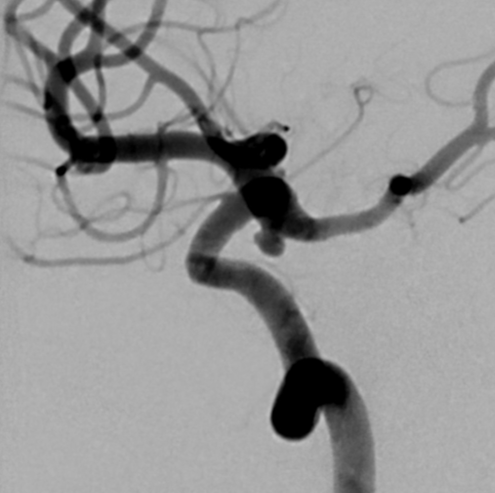
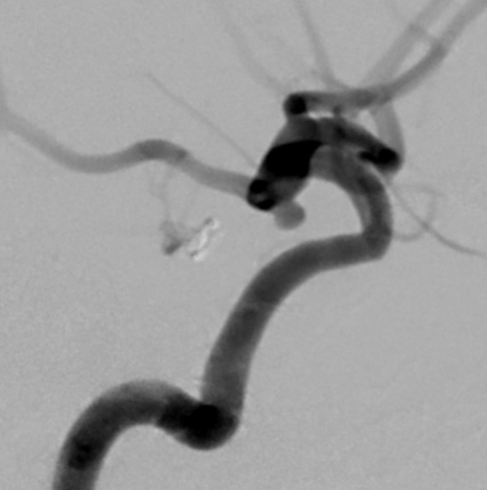
View A is AP; View B is lateral, as confirmed by the data provider.
Case summary
A 62-year-old female presents for treatment of a 2.6mm right PCOM aneurysm with a 2.3mm neck, situated in a fetal-type posterior circulation configuration.
Image observation
On the supplied views, the aneurysm appears as a distinct outpouching at the PCOM origin with a clearly defined neck and adjacent branching vessels.
Model-generated clinical rationale
The assigned recommendation of coil embolization alone is supported by the aneurysm's small size and the documented distinct neck, which may allow for stable coil retention. However, the relatively wide neck-to-dome ratio and the presence of a fetal-type PCOM artery introduce complexity regarding coil stability and branch preservation. The recommendation appears questionable without explicit documentation of the neck width relative to the dome or the specific 3D orientation of the PCOM origin.
Model uncertainty
The OOF score distribution was diffuse: Coil embolization alone ranked first, but Stent-assisted coil embolization remained a material alternative.
Clinical uncertainty / missing factor
The most critical missing decision factor is the precise 3D relationship between the aneurysm neck and the PCOM origin, which determines the feasibility of coil-only treatment versus the need for stent assistance.
Explicit evidence used
2.6mm x 2.4mm x 2.4mm aneurysm with 2.3mm neck | Fetal-type posterior cerebral artery