Complete cohort - Case 64 of 83
Case 79
Assigned out-of-fold recommendation
Flow diversion alone
Alternative: Coil embolization alone
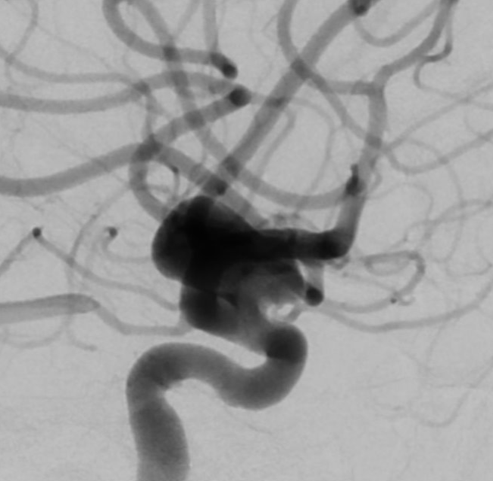
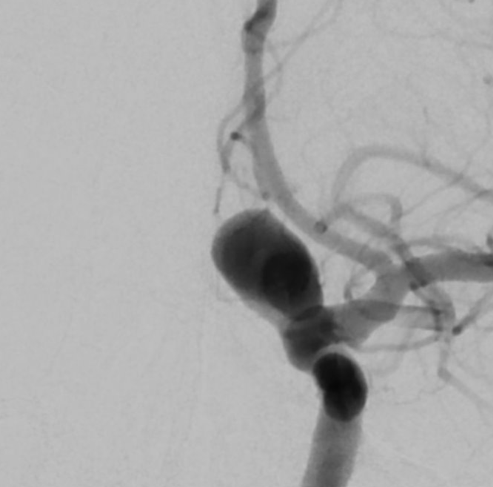
View A is AP; View B is lateral, as confirmed by the data provider.
Case summary
A 55-year-old female presents with an incidental, unruptured left ophthalmic artery aneurysm measuring 15.2 x 8.4 x 7.2 mm with a 4 mm neck.
Image observation
On the supplied views, a large, irregular aneurysm appears to arise from the supraclinoid internal carotid artery with a wide neck and complex fundus.
Model-generated clinical rationale
The assigned recommendation of flow diversion alone is supported by the aneurysm's large size and wide neck, which may complicate coil-only stability. However, the documented origin of the ophthalmic artery from the aneurysm fundus presents a significant challenge for flow diversion, as it risks branch occlusion. The rationale is limited by the inability to confirm the precise angle of branch incorporation from the static images.
Model uncertainty
The OOF classifier scores for Flow diversion alone and Coil embolization alone were close, so the assigned recommendation should be treated as uncertain.
Clinical uncertainty / missing factor
The most critical missing decision factor is the precise spatial relationship between the ophthalmic artery origin and the aneurysm neck, which determines the safety of flow diversion versus the feasibility of adjunctive coiling.
Explicit evidence used
Aneurysm dimensions 15.2 x 8.4 x 7.2 mm with 4 mm neck | Ophthalmic artery originates from the anterior dome of the aneurysm fundus