Complete cohort - Case 70 of 83
Case 85
Assigned out-of-fold recommendation
Coil embolization alone
Alternative: Flow diversion alone
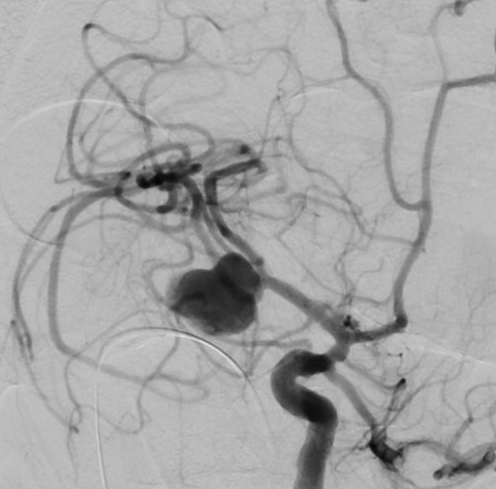
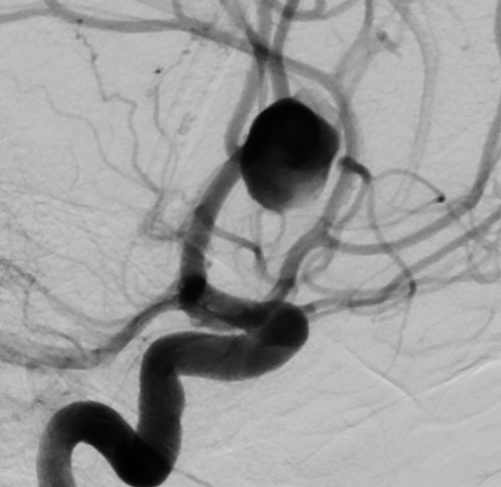
View A is AP; View B is lateral, as confirmed by the data provider.
Case summary
A 53-year-old female presented with a subarachnoid hemorrhage caused by a ruptured right middle cerebral artery aneurysm.
Image observation
On the supplied views, a large saccular aneurysm appears to arise from the right MCA bifurcation, with contrast filling the M1 segment and distal branches.
Model-generated clinical rationale
The assigned recommendation of coil embolization alone is supported by the documented 2.8-mm neck width, which suggests a geometry potentially amenable to endovascular occlusion. However, the large aneurysm dimensions (12.6 mm) and the context of a ruptured MCA bifurcation lesion may limit the durability of coiling alone, as the model uncertainty indicates flow diversion remains a material alternative.
Model uncertainty
The OOF score distribution was diffuse: Coil embolization alone ranked first, but Flow diversion alone remained a material alternative.
Clinical uncertainty / missing factor
The most significant missing decision factor is the specific assessment of branch vessel incorporation at the bifurcation, which is critical for determining the feasibility of flow diversion versus coiling.
Explicit evidence used
Ruptured right MCA aneurysm | Aneurysm dimensions 12.6mm x 10.6mm x 9.0mm with 2.8-mm neck