Complete cohort - Case 77 of 83
Case 93
Assigned out-of-fold recommendation
Coil embolization alone
Alternative: Balloon-assisted coil embolization
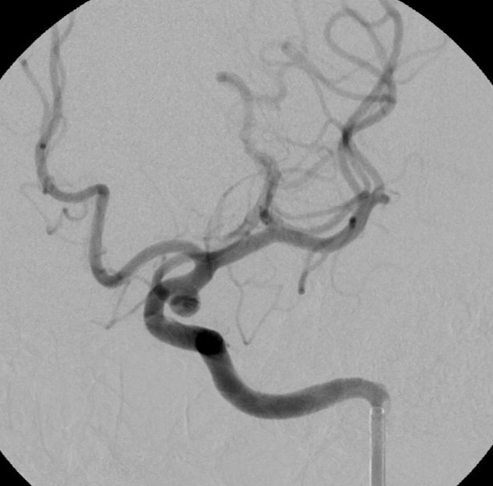
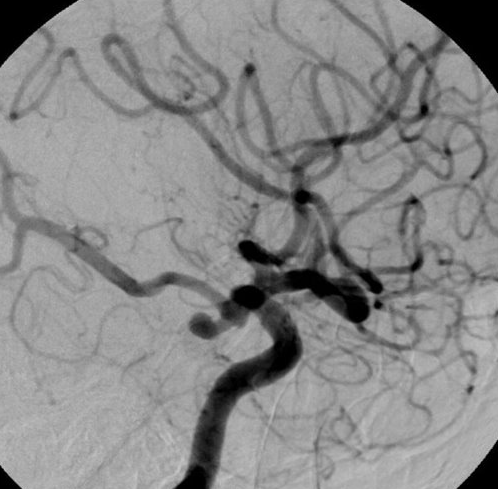
View A is AP; View B is lateral, as confirmed by the data provider.
Case summary
A 52-year-old female presented with a Hunt and Hess 4, Fisher 3 subarachnoid hemorrhage caused by a 4.4 x 4.9 x 3.5 mm comma-shaped left PCOM aneurysm with a 2.1 mm neck.
Image observation
On the supplied views, the aneurysm appears as a distinct outpouching from the posterior communicating artery segment with a clearly defined neck.
Model-generated clinical rationale
The assigned recommendation of coil embolization alone is supported by the aneurysm's small size and the documented 2.1 mm neck, which may be amenable to simple packing. However, the presence of a dysplastic infundibulum and the aneurysm's dorsal projection could complicate coil stability, potentially necessitating balloon assistance despite the model's preference.
Model uncertainty
The OOF classifier showed a relatively clear preference for Coil embolization alone over Balloon-assisted coil embolization, but its scores are not probabilities of clinical correctness.
Clinical uncertainty / missing factor
The most significant missing factor is the precise morphological relationship between the aneurysm neck and the infundibulum, which is critical for determining if the neck is wide enough to require balloon remodeling.
Explicit evidence used
4.4 x 4.9 x 3.5 mm comma shaped PCOM aneurysm | 2.1 mm neck