Complete cohort - Case 9 of 83
Case 12
Assigned out-of-fold recommendation
Balloon-assisted coil embolization
Alternative: Coil embolization alone
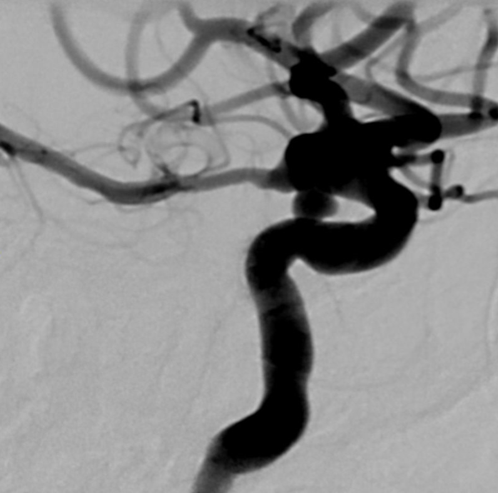
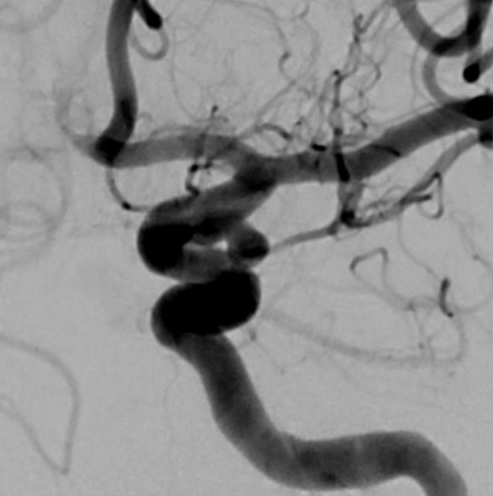
View A is AP; View B is lateral, as confirmed by the data provider.
Case summary
A 46-year-old female presented with subarachnoid hemorrhage and bilateral posterior communicating artery aneurysms, with the right-sided lesion measuring 7mm x 5mm x 5.3mm and possessing a 4.8mm neck.
Image observation
On the supplied views, the aneurysm appears as a large, lobulated outpouching arising from the internal carotid artery with a wide neck and complex morphology.
Model-generated clinical rationale
The assigned recommendation of balloon-assisted coil embolization is supported by the documented wide neck (4.8mm) and the complex morphology of the right-sided aneurysm, which typically necessitates temporary balloon remodeling to maintain coil stability. However, the utility of this technique is limited by the lack of documented assessment regarding the size of the posterior communicating artery origin relative to the aneurysm neck.
Model uncertainty
The OOF score distribution was diffuse: Balloon-assisted coil embolization ranked first, but Coil embolization alone remained a material alternative.
Clinical uncertainty / missing factor
The most significant missing decision factor is the precise spatial relationship between the aneurysm neck and the origin of the posterior communicating artery, which determines the feasibility of balloon remodeling versus stent assistance.
Explicit evidence used
7mm x 5mm x 5.3mm aneurysm with 4.8mm neck | complex morphology of this aneurysm