Complete cohort - Case 19 of 83
Case 23
Assigned out-of-fold recommendation
Coil embolization alone
Alternative: Stent-assisted coil embolization
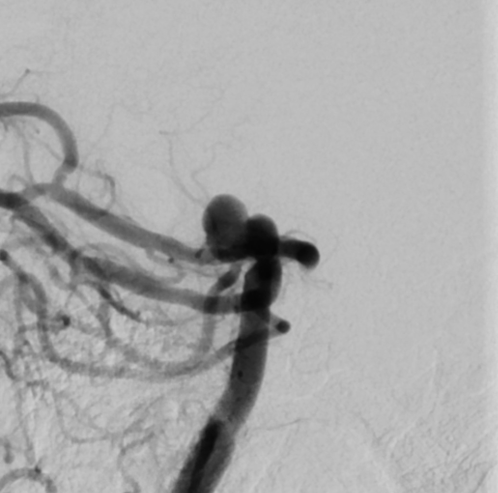
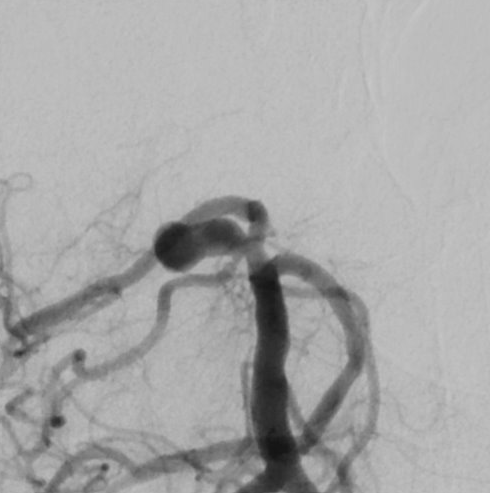
View A is AP; View B is lateral, as confirmed by the data provider.
Case summary
A 65-year-old female with subarachnoid hemorrhage presents with a bilobed right superior cerebellar artery aneurysm measuring 8.5 mm x 3.5 mm x 8 mm with a 2.4 mm neck.
Image observation
On the supplied views, the aneurysm appears as a bilobed outpouching arising from the superior cerebellar artery with a clearly defined neck.
Model-generated clinical rationale
The assigned recommendation of coil embolization alone is supported by the documented 2.4 mm neck width, which suggests a geometry potentially amenable to primary coiling. However, the bilobed morphology and the aneurysm's location on the superior cerebellar artery may complicate coil stability, potentially necessitating adjunctive support.
Model uncertainty
The OOF classifier scores for Coil embolization alone and Stent-assisted coil embolization were close, so the assigned recommendation should be treated as uncertain.
Clinical uncertainty / missing factor
The feasibility of primary coiling remains uncertain without explicit documentation of the dome-to-neck ratio or the specific angulation of the aneurysm neck relative to the parent vessel.
Explicit evidence used
8.5 mm x 3.5 mm x 8 mm bilobed aneurysm | 2.4 mm neck