Complete cohort - Case 37 of 83
Case 46
Assigned out-of-fold recommendation
Coil embolization alone
Alternative: Flow diversion alone
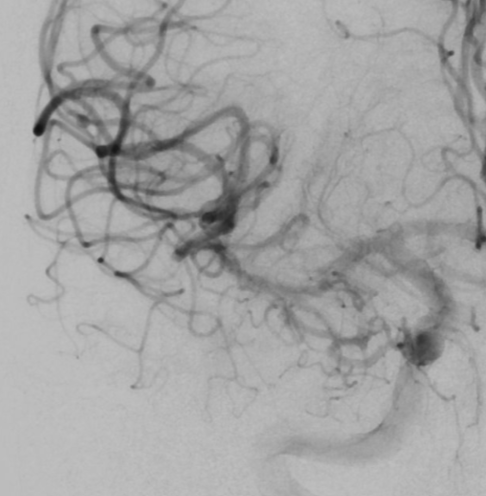
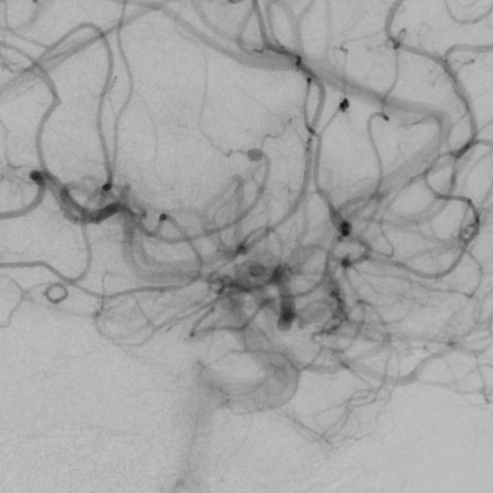
View A is AP; View B is lateral, as confirmed by the data provider.
Case summary
A 54-year-old male presents with subarachnoid hemorrhage and multifocal intracerebral hemorrhage, with evidence of progression of a 2.5 mm x 2.3 mm x 2.1 mm dissecting aneurysm in a right M3/4 branch.
Image observation
On the supplied views, a small aneurysmal outpouching appears to arise from a distal MCA branch, with a noted paucity of vessels in the adjacent region of known intracerebral hemorrhage.
Model-generated clinical rationale
The assigned recommendation of coil embolization alone is supported by the small dimensions of the aneurysm and the need for immediate treatment of a progressing lesion. However, the documented dissecting morphology and distal M3/4 location may limit the feasibility of this approach, as flow diversion is often preferred for dissecting lesions but may be technically challenging in distal branches.
Model uncertainty
The OOF score distribution was diffuse: Coil embolization alone ranked first, but Flow diversion alone remained a material alternative.
Clinical uncertainty / missing factor
The most important missing decision factor is the precise neck width and morphology of the dissecting aneurysm, which are critical for determining the feasibility of coil embolization versus flow diversion.
Explicit evidence used
2.5 mm x 2.3 mm x 2.1 mm dissecting aneurysm in a M3/4 branch | evidence of progression of an associated right M3/4 segment aneurysm