Complete cohort - Case 38 of 83
Case 47
Assigned out-of-fold recommendation
Coil embolization alone
Alternative: Stent-assisted coil embolization
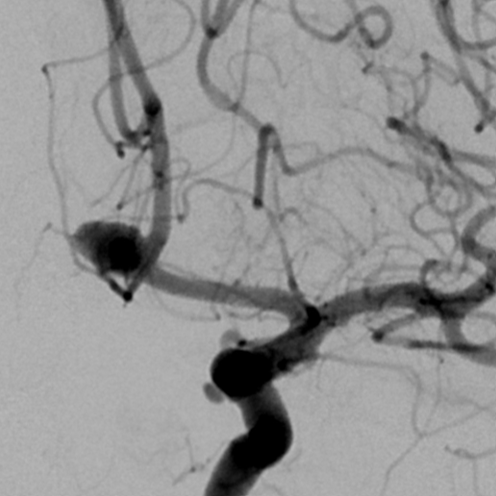
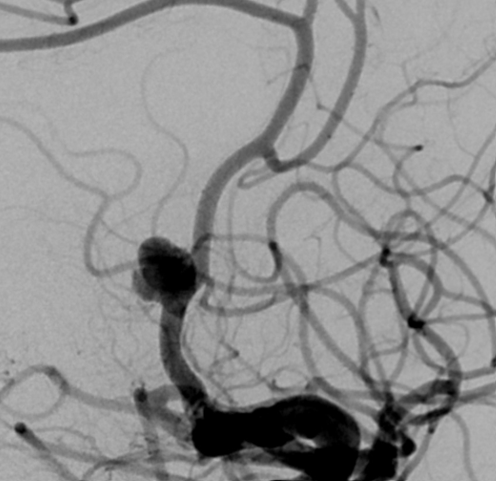
View A is AP; View B is lateral, as confirmed by the data provider.
Case summary
A 58-year-old female presents with an unruptured, cranially oriented saccular anterior communicating artery aneurysm measuring 6.1 x 5.8 x 4.7 mm with a 2.7 mm neck.
Image observation
On the supplied views, a saccular outpouching appears at the anterior communicating artery junction with adjacent branch vessels.
Model-generated clinical rationale
The assigned recommendation of coil embolization alone is supported by the documented 2.7 mm neck width, which suggests a geometry potentially amenable to primary coiling. However, the cranial orientation and the presence of robust filling to the contralateral ACA introduce complexity regarding coil stability and potential branch occlusion. The recommendation remains limited by the lack of explicit documentation regarding the specific relationship between the aneurysm neck and the origin of the contralateral ACA.
Model uncertainty
The OOF score distribution was diffuse: Coil embolization alone ranked first, but Stent-assisted coil embolization remained a material alternative.
Clinical uncertainty / missing factor
The precise anatomical relationship between the aneurysm neck and the contralateral ACA origin is not explicitly defined, creating uncertainty regarding the necessity of adjunctive stenting.
Explicit evidence used
6.1 x 5.8 x 4.7 mm cranially oriented saccular Acomm aneurysm | neck measuring approximately 2.7 mm