Complete cohort - Case 41 of 83
Case 50
Assigned out-of-fold recommendation
Coil embolization alone
Alternative: Flow diversion alone
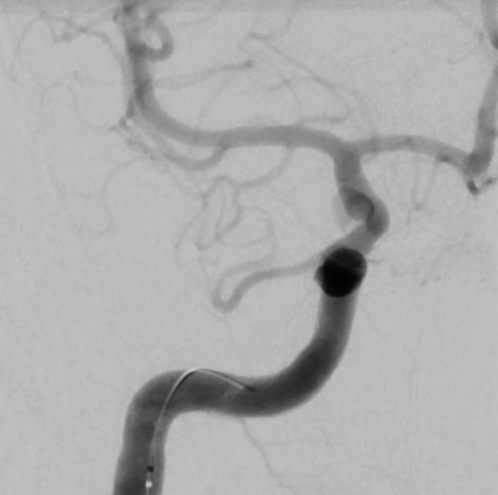
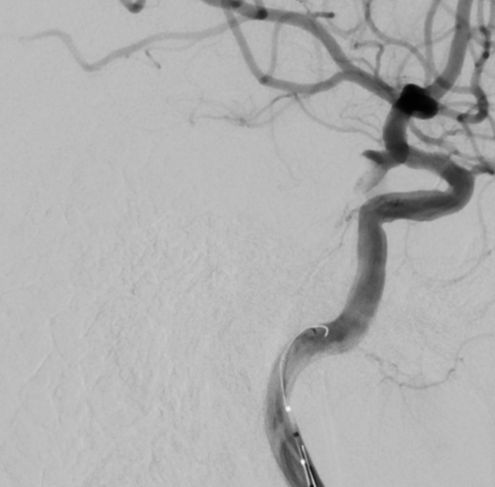
View A is AP; View B is lateral, as confirmed by the data provider.
Case summary
A 56-year-old female presented with an aneurysmal subarachnoid hemorrhage caused by a ruptured 2.7 mm x 3 mm x 2.5 mm right posterior communicating artery aneurysm.
Image observation
On the supplied views, a saccular outpouching appears on the right internal carotid artery, with a catheter visible within the vessel lumen.
Model-generated clinical rationale
The documented small dimensions of the aneurysm and the presence of a ruptured status are factors that may support the selection of coil embolization. However, the specific neck width and the precise relationship to the posterior communicating artery origin are not fully detailed, which limits the ability to confirm the feasibility of coil-only treatment versus adjunctive techniques.
Model uncertainty
The OOF classifier showed a relatively clear preference for Coil embolization alone over Flow diversion alone, but its scores are not probabilities of clinical correctness.
Clinical uncertainty / missing factor
The most significant missing decision factor is the precise neck-to-dome ratio and the exact incorporation of the posterior communicating artery origin, which are critical for determining the stability of a coil-only construct.
Explicit evidence used
Ruptured 2.7 mm x 3 mm x 2.5 mm right posterior communicating artery aneurysm | 56-year-old female with aneurysmal subarachnoid hemorrhage