Complete cohort - Case 44 of 83
Case 53
Assigned out-of-fold recommendation
Coil embolization alone
Alternative: Flow diversion with coil embolization
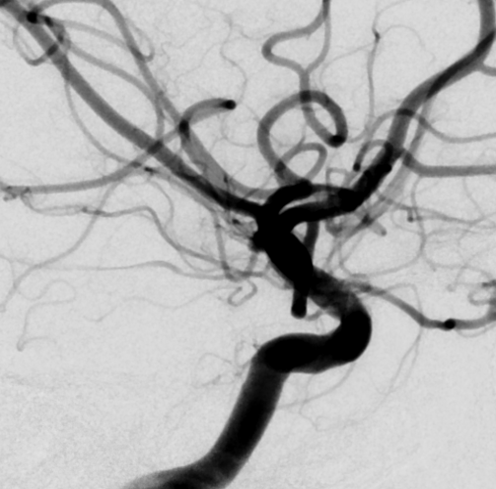
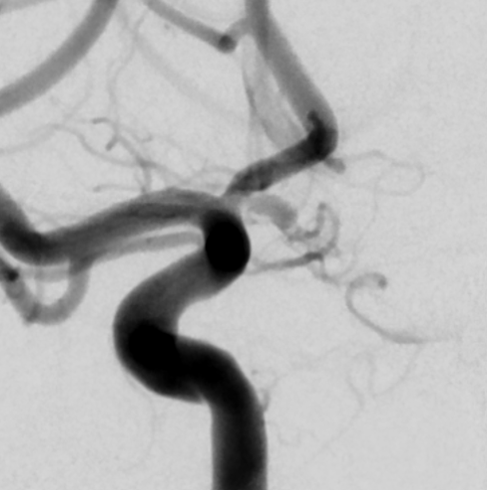
View A is AP; View B is lateral, as confirmed by the data provider.
Case summary
A 41-year-old female presented with aneurysmal subarachnoid hemorrhage caused by a 3.4mm x 1.6mm x 2.6mm elongated saccular aneurysm at the right ACA origin.
Image observation
On the supplied views, the aneurysm appears as a distinct outpouching at the carotid terminus with a tortuous vessel course.
Model-generated clinical rationale
The assigned recommendation of coil embolization alone is supported by the aneurysm's small size and saccular morphology, which are generally amenable to endovascular occlusion. However, the documented elongated shape and lack of specific neck-width measurements limit the certainty of coil stability without adjunctive devices.
Model uncertainty
The OOF score distribution was diffuse: Coil embolization alone ranked first, but Flow diversion with coil embolization remained a material alternative.
Clinical uncertainty / missing factor
The precise neck-to-dome ratio and the exact relationship of the aneurysm neck to the A1 segment origin are not explicitly quantified, which are critical factors for determining the feasibility of coil-only treatment versus flow diversion.
Explicit evidence used
3.4mm x 1.6mm x 2.6mm elongated saccular aneurysm | Aneurysmal SAH