Complete cohort - Case 56 of 83
Case 71
Assigned out-of-fold recommendation
Stent-assisted coil embolization
Alternative: Flow diversion alone
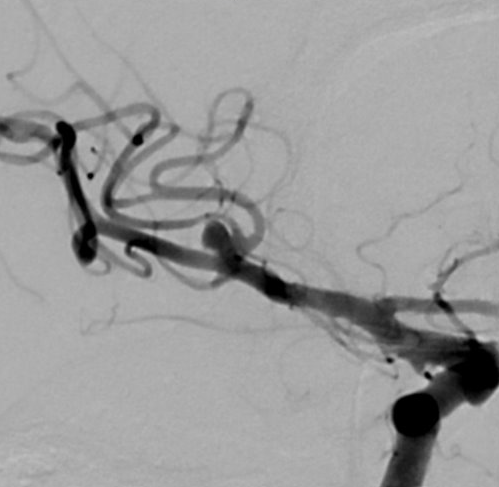
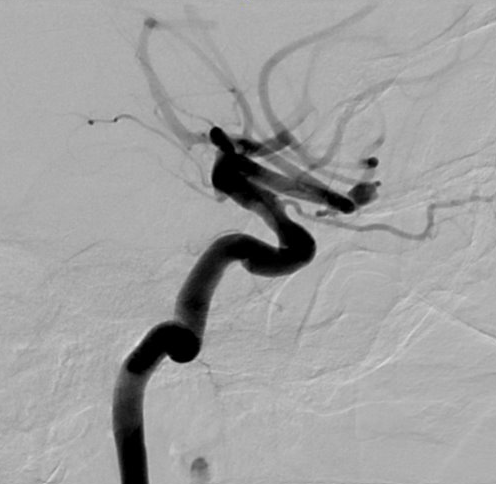
View A is AP; View B is lateral, as confirmed by the data provider.
Case summary
A 50-year-old female with a right frontal intracerebral hemorrhage is presented for elective treatment of a 3 x 3.3 x 2.8 mm right MCA bifurcation aneurysm with a 2 mm neck.
Image observation
On the supplied views, the aneurysm appears as a saccular outpouching at the MCA bifurcation with contrast filling the adjacent M1 and M2 segments.
Model-generated clinical rationale
The assigned recommendation of stent-assisted coil embolization is supported by the aneurysm's bifurcation location and 2 mm neck, which may require stent support to maintain coil stability. However, the small aneurysm dimensions and the presence of a bifurcation pose technical challenges for stent deployment and potential branch occlusion.
Model uncertainty
The OOF score distribution was diffuse: Stent-assisted coil embolization ranked first, but Flow diversion alone remained a material alternative.
Clinical uncertainty / missing factor
The critical missing decision factor is the precise anatomical relationship of the aneurysm neck to the M2 branch origins, which determines the feasibility of stent placement without compromising branch patency.
Explicit evidence used
Right MCA bifurcation aneurysm with 2 mm neck | Aneurysm dimensions 3 x 3.3 x 2.8 mm