Complete cohort - Case 72 of 83
Case 87
Assigned out-of-fold recommendation
Flow diversion alone
Alternative: Coil embolization alone
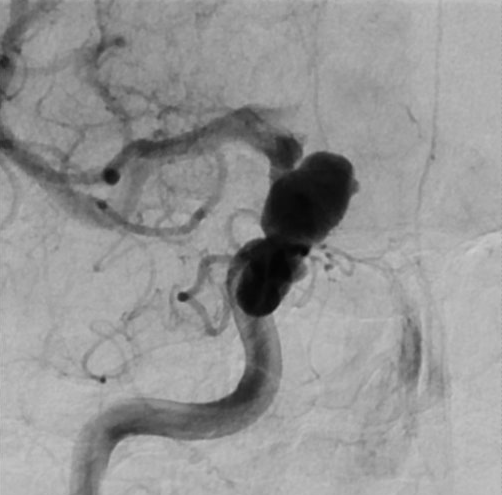
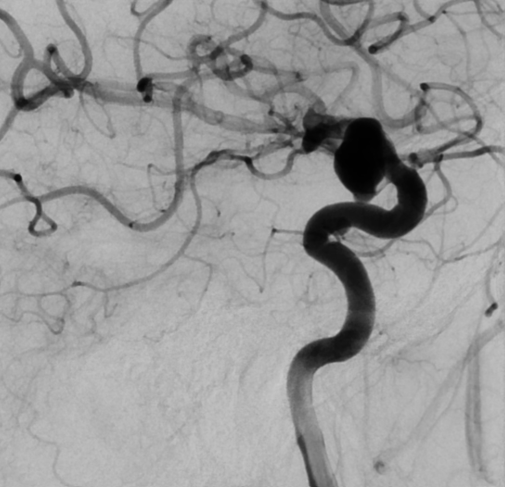
View A is AP; View B is lateral, as confirmed by the data provider.
Case summary
A 52-year-old female presents for elective treatment of unruptured right internal carotid artery aneurysms located at the posterior communicating and anterior choroidal artery origins.
Image observation
On the supplied views, a large, bilobed aneurysmal sac appears to arise from the supraclinoid internal carotid artery, with a distinct parent vessel course visible.
Model-generated clinical rationale
The assigned recommendation of flow diversion alone is supported by the large dimensions of the posterior communicating artery aneurysm (9.0 x 11.6 mm), which may be challenging to treat with coils alone. However, the presence of a moderate-sized PCOM artery and a concurrent anterior choroidal artery aneurysm complicates the decision, as flow diversion carries a risk of branch vessel occlusion.
Model uncertainty
The OOF classifier scores for Flow diversion alone and Coil embolization alone were close, so the assigned recommendation should be treated as uncertain.
Clinical uncertainty / missing factor
The critical missing decision factor is the precise anatomical relationship of the aneurysm neck to the origins of the PCOM and anterior choroidal arteries, which determines the feasibility of preserving branch patency with flow diversion.
Explicit evidence used
9.0 mm x 11.6 mm PCOM aneurysm dimensions | Moderate sized PCOM artery